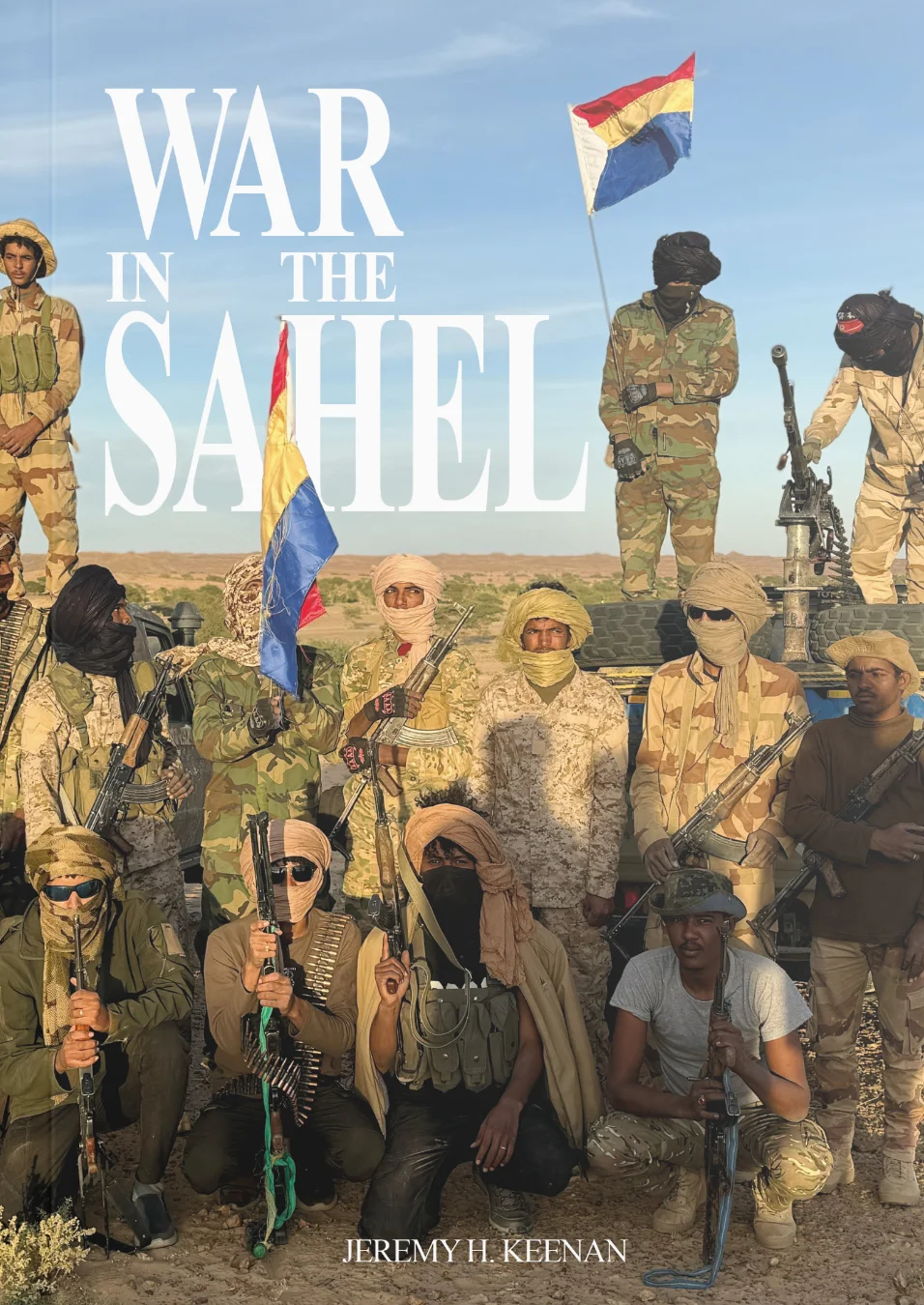
War in The Sahel
Purchase on AmazonThis ground-breaking, 500-page, analysis of the War in the Sahel follows the author’s seminal work: The Global War on Terror in the Sahara. War in the Sahel covers the ‘second half’ of the GWOT in northern Africa, starting with France’s military intervention in Mali in 2013. This book explains, through the author’s unique experience and scholarly insight: the US’ failed attempt to establish the concept of a global narco-terrorism network; the failure of France’s military intervention; the emergence of the ‘coup bloc’ of African countries (Mali, Burkina Faso and Niger); the growth of jihadism in the Sahel and the increasing Russification of the region. The 24 chapters analyse: the tragedy that has engulfed Sahelian Africa: how ‘jihadists’ have increased their presence in the region; the circumstances in which more than 70,000 people have been killed and two million displaced; why Russian-aligned military juntas have replaced democratically elected governments and why Russia’s increasing hold over these African states is being described as Vladamir’s Putin’s ‘Second Front’ in Russia’s undeclared war on the West.
The irony for those US ideologues who planned the Project for a New American Century (PNAC) and then exerted almost unchallenged influence in George W. Bush’s administration that took power in January 2001, is that their ill-conceived GWOT has led to the precise opposite outcome. Far from enabling the USA to gain the “global leadership” that the PNAC envisaged, the GWOT, has resulted in widespread death, suffering and destruction across Sahelian Africa and the withdrawal of America from much of the Continent, thereby enabling Vladimir Putin’s Russia to further its push for ascendency in Africa.
Reviews & critics
This extraordinary book, a sequel to The Global War on Terror in the Sahara, carries the reader on a scholarly journey unlike any I’ve been on before. Jeremy Keenan, an anthropologist, is both an expert on the Sahel region – that oft-ignored band of countries crossing north Africa, and an expert on America’s global war on terror. In this majestic and deeply scholarly account, Keenan brings both these areas of expertise together in an explosive analytical narrative. His purpose is to offer an understanding of ‘how the Sahel came to be in its current seemingly dystopian state’. Throughout, the story recounts the brutal victimisation and courageous resistance of the indigenous Tuareg. Focusing on the political and military dynamics between global and regional powers, Keenan documents and analyses in vivid detail the role of France, Russia and the US and the corrupt and brutal regimes in Niger, Mali, Algeria, Chad, Burkina Faso and Libya in their competing efforts to control the region’s populations and resources.
Keenan highlights five central issues which have played a fundamental role both during (2012-) and in extending, the long, now seemingly never-ending war in the Sahel: French colonialism; Tuareg secessionism; Algeria; jihadism and trans-Saharan criminal trafficking networks. In later chapters the book explores post-colonial struggles, anti-French sentiment and the increasing Russification of the Sahel (not least through the crimes of the Wagner group) as playing a crucial part in extending the war. Military coups in Burkina Faso and Mali and the West’s declining influence in the Sahel are all explained in scholarly yet highly accessible detail for the roles they have played in this lethal war.
The book offers a particularly illuminating analysis of the ‘ignominy’ that France suffered as a result of the expansion and military successes of regional jihadists and the former colonial power’s effective expulsion from the region, only to be replaced by ‘hordes of barbaric Russian mercenaries’.
But the book’s special value, particularly for those less familiar with the Sahel and its geo-political complexities, is its exposure of regional dictatorships, violent coups, lethal collaborations, corruption and state crime. The appointment of General El Hadji ag Gamou as governor of the Kidal region by the Malian dictatorship in November 2023, for example, led directly to the genocide of the ‘white-skinned’ Tuareg and Arab peoples of the region, about which Keenan has written in depth elsewhere.
Particularly illuminating are the lethal connections Keenan exposes between regional regimes and their cultivation, and sometimes creation, of Jihadist groups. Three infamous militant groups - AQIM, MUJAO and Ansar al-Dine - the book reveals, were led directly or indirectly by Algeria’s infamous intelligence service the DRS. And as Keenan reveals, many recruits were reluctant Jihadists – often forced to join under duress or driven by poverty, ‘attracted by the promise of money, a weapon, motorcycle and the promise of a better future.’ Others joined to avenge the murders of family members by Sahel armies and pro-regime militias.
We learn about the Tuareg’s National Movement for the Liberation of Azawad (MNLA) and the movement’s declared intentions in late 2011 to create an independent secular state of Azawad in northern Mali. This move to secede posed a serious threat to Algerian territorial authority, and its response, as Keenan demonstrates so vividly was to create more jihadist groups, notably MUJAO and Ansar al-Dine, and to launch an Islamist insurgency into northern Mali that would overwhelm the MNLA both politically and militarily. The level of explanatory detail, which characterises every chapter of this powerful book, counters the dominant Western narrative of Islamist terrorism and reveals just how central the state – in this case Algeria – has been in the cultivation of Islamist ‘terror’, and the extent to which it will go in order to secure its own political and economic organisational goals.
This powerful book must be also seen as an authoritative body of evidence of the crimes committed by a range of regional and global powers against the indigenous Tuareg and other groups – crimes which include state-sponsored massacres, mass atrocities, forced evictions and genocide. This book is thus a critical adjunct to Tuareg civil society’s own efforts to gather evidence of the crimes being committed against them and a vital contribution to state crime scholarship.
Jeremy Keenan possesses an extraordinary gift for illuminating and demystifying the long and complex histories of state crime, factionalism, war and dictatorship in the Sahel. In this remarkable book, he brings these histories together with meticulous research, compelling evidence and often shocking examples, revealing the forces that have shaped the region and its seemingly endless war.
Written with exceptional clarity and narrative force, this is both a gripping account of a region in turmoil and a profound indictment of the powerful actors responsible for its suffering. Keenan exposes political corruption and genocidal violence while tracing the enduring resistance of the Tuareg to these violations. For anyone seeking to understand the Sahel, its history, its crimes and its struggles for justice, there is simply no more important or compelling book.
Penny Green
Professor of Law and Globalisation
Director, International State Crime Initiative
Queen Mary University of London