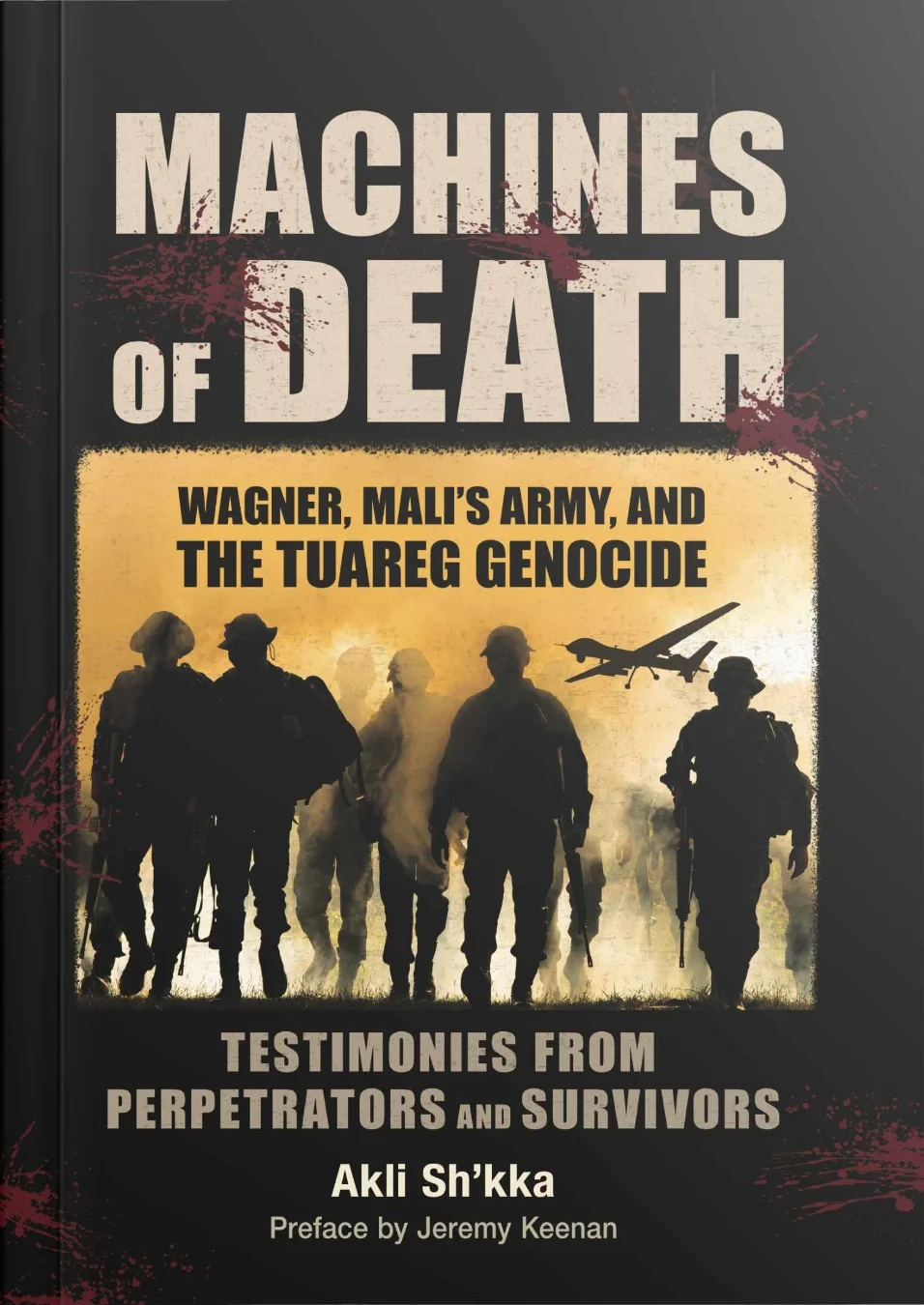
Machines of Death
Coming soonPreface to Machines of Death
Preface by Jeremy H. Keenan
Visting Professor
School of Law
Queen Mary University London
Machines of Death is possibly the most powerful and important book that has been written on the Tuareg. If history proves me wrong, I think I am right in saying that no other piece of writing on the Tuareg, book or article, especially written by a Tuareg, will move you – the reader – so readily to tears.
I have known the author, Akli, for sixteen years, since he first arrived in England in 2009 after an extraordinary journey from the Sahara, which hopefully might one day become the story of another book. When he told me that he was preparing this book – about the testimonies of the survivors, victims and perpetrators of Mali’s current genocide against the Tuareg, I offered to help with its editing and proofing, not because I thought it would need much editing, but because I wanted it to become available to the world as soon as possible.
When I read Akli’s draft manuscript, I was moved by his empathy for his fellow Tuareg and impressed by his linguistic ability and frequent poetic use of expression that has underpinned my admiration – which I should be honest enough to call envy – for the Tuaregs’ almost instantaneous grasp of foreign languages, which has never ceased to amaze me since I first travelled amongst them more than 60 years ago. It is a facet of an intellectual ability that has not only enabled them to survive in such a seemingly inhospitable environment and make it their home over countless centuries, but to keep one step ahead of the threatening vicissitudes of the ever-changing world around them, from well before the time of France’s threatening encroachment into the Sahara in the nineteenth century to their emerging and unenviable role as proxies in what is fast taking on the appearance of a new Cold War.
However, I must warn the reader that Akli’s extraordinary manuscript is a hard read, not for any linguistic or semantic reasons, but simply because the moisture in my eyes made it difficult to see the print clearly. Few people will be able to read this book without being reduced to tears.
Akli did not invite me to write this preface. As soon as I had finished reading the draft, I asked him if he would allow me to write one, not to help boost sales, although I hope it becomes widely read, but because I wanted to explain to readers who do not know Akli, and who are perhaps unfamiliar with the extremely complicated political situation in this part of North Africa where they live and what has happened recently to the Tuareg people – the so-called ‘Blue-Veiled warriors’ of much traditional literature – who are the Sahara’s indigenous, nomadic peoples, why this is such an important piece of writing.
It is important that Akli’s voice does not become drowned out and subsumed by the bigger killing fields of our day: Israel’s genocide in Gaza; Putin’s war crimes in Ukraine; the resurgence of Janjaweed ethnocidal massacres in Sudan. Nor must the genocide being perpetrated against the Tuareg by Mali’s ’colonel-to-Field Marshall’ Assimi Goïta and his Russian allies be ignored or crowded out and reduced to little more than a footnote of history by the mainstream media’s overriding concern with the rise of fascism, selfishness and greed in Trump’s America and other parts of the Western World.
The number of innocent Tuareg civilians killed by Goïta’s army and its Russian allies during 2023 and 2024 was in the hundreds. That number has now risen, and is still increasing, into the thousands, with more than 100,000 having already fled the slaughter and found refuge in neighbouring countries. While this number may be small compared to those killed in Gaza, Ukraine and Sudan, it is no reason for the world to turn a blind eye to what the victims of Assimi Goïta’s genocide call an ‘ethnocide’. In such a semi -nomadic, close-knit desert community, where survival sometimes appears as miraculous, even a handful of deaths is catastrophic.
Akli’s book is important for two reasons. Firstly, it gives insight into the thoughts, beliefs, values and hence actions of a Tuareg who is perhaps the most significant and influential voice of his people on the international stage. Secondly, in his roles as witness, journalist and writer, Akli has compiled a record, by collecting the testimonies – shocking and deeply moving – of the perpetrators and survivors of Mali’s genocide, which Mali’s rulers and their Russian allies, have been trying to keep hidden from the world. Mali’s new regime, supported by its fellow Russophile juntas in neighbouring Niger and Burkina Faso, has stated that it does not recognise the authority of the International Criminal Court (ICC), which it calls an "instrument of neo-colonialist repression", and has announced its immediate withdrawal. However, it has not taken this decision because of its purported and perhaps justified aversion to ‘neocolonialism’, but because it knows that if it remains a member of the ICC and is charged with crimes of genocide, it will be found guilty of the world’s most wretched crime. Unfortunately for Assimi Goïta, his withdrawal from the ICC does not take effect immediately. Rather, a country's withdrawal from the ICC officially takes effect one year after the UN is notified. Therefore, the Tuareg still have several months in which to lodge their case against Mali’s military regime with the ICC. In 2023, the ICC issued an arrest warrant for Russia’s President Putin over alleged war crimes in Ukraine. He might still find himself facing another warrant for his complicity in genocide in Mali.
Akli was born in 1983 into a nomadic Tuareg family that roamed the vast stretches of the Sahara. For the first seven years of his life, he worked as a herder, tending livestock across the desert's unforgiving terrain. Shortly after I first met him, he was telling me stories about the Acacus Mountains of Libya’s Fezzan region, one of the most beautiful and spectacular corners of the great desert and where he spent many of these early years. The Acacus Mountains are adjacent to the Tassili-n-Ajjer, the home of the best-known and most famous prehistoric rock-art of the Sahara. For Akli, the Tassili would have been no more than a day or two’s walk from the Acacus. It is therefore no wonder that this phenomenal art gallery features so much in his concerns for Tuareg heritage – and in the pages of this book. At the age of five, like most nomadic Tuareg children, he began learning Tifinagh – the ancient script of his people – passed down through generations as both language and cultural lifeline.
At the age of seven, Akli's nomadic childhood gave way to formal education when he was enrolled in primary school in Sebha, southern Libya, where he would spend his formative years. His family, like countless Tuareg clans, remained scattered across the Sahara, from southern Libya and across southern Algeria and Niger to the Adrar-n-Ifoghas (Iforas) Mountains of northern Mali’s Kidal region. Borders meant nothing to them; the desert was their home.
Not long after his arrival in the UK, Akli established the Tifinagh Association, dedicated to preserving and advocating for Tuareg culture and identity in a world that had consigned them to history and which has now perhaps conveniently ‘overlooked’ or ignored the genocide that the Mali government is perpetrating against them. Three years later, in 2012, he founded the Imouhagh International Organisation for Justice and Transparency, focusing specifically on Tuareg rights and political representation. The organisation quickly gained traction, and Akli emerged as one of the most influential and recognisable Tuareg voices across the entire Sahara region.
His activism propelled him onto international stages. He became a regular media commentator and a frequent attendee at the UN Permanent Forum on Indigenous Issues, as well as at numerous international conferences addressing indigenous rights, statelessness, and cultural preservation. His network of contacts and encyclopaedic knowledge of Saharan politics led to him becoming known as the "Black Box of the Sahara."
Two years later, in 2014, he launched Toumast TV, the first-ever Tuareg television station. The name "Toumast" – meaning "identity" in Tamashek and also a popular name given to Tuareg and Berber girls – reflected his mission: to give his people visibility and voice in a media landscape that had rendered them invisible.
A prolific writer in both Arabic and English, Akli has documented the Tuareg struggle extensively. In 2020, he published Man of the Sahara: A Long Walk to Tuareg Statehood, chronicling the historical and contemporary fight for Tuareg autonomy. Two years later, in 2022, he released The Serum of Truth: Memoirs of a Tuareg Militant in Arabic, offering an unflinching insider's account of life as a Tuareg activist navigating a world divided by colonial borders and modern nation-states that have either refused to take heed of his people's existence, trampled on their identity, or, in the case of Assimi Goïta’s Mali, perpetrate a genocide against them.
Machines of Death, a title that becomes frighteningly clear from many of the victims’ testimonies, is in two Parts.
The first and shorter Part provides a Tuareg’s (Akli’s) account of his people’s “long struggle for an independent Azawad”. It comprises four chapters in which Akli recounts how his people have struggled in their quest for Justice and Independence. At times slightly polemical, Akli highlights key aspects of Tuareg history, such as: their warning letter to General de Gaulle; the roots of almost perpetual conflict and past rebellions; the contentious Algiers Accord of 2015; Mali’s coup d’état of 2020 and the rise of Assimi Goïta’s junta.
Part II, the major part of the Book, entitled ‘Voices of Survival’ consists of Akli’s interviews with the survivors of the Genocide being perpetrated by Assimi Goïta and his Russian allies that commenced, from a technical and legal perspective, in late 2023.
It is this second part of Akli’s book, some 115 pages of shocking, gruesome testimonies, collected, recorded and catalogued by Akli, that are so difficult to read, and which I leave for the Reader to digest, with the reminder that these cruelties, these barbaric bestialities, these crimes against humanity, are being perpetrated today on the same planet as the crimes against humanity being perpetrated in Gaza, Ukraine, and Sudan. While Gaza, Ukraine and Sudan are the subjects of world media headlines, the genocide being perpetrated in Mali has so far been completely ignored by the so-called ‘international community’ despite warnings, requests and pleas for help.
Assimi Goïta and his Russian friends, and those neighbouring states, such as Niger and Burkina Faso, that are perhaps being tempted to follow in their footsteps, will doubtless continue to try and deny the crimes that have been committed. They will no doubt continue to persist with their Trumpian language, claiming that these ‘stories’ are just ‘fake news’ and ‘neocolonial propaganda’. If they read Akli’s book, their response will almost certainly be to decry it as ‘lies’, and no doubt adding such personal insults as saying to the effect that “Akli is just a Tuareg: he would say that, wouldn’t he?”.
My reason for wanting to write this Preface is to confirm that the testimonies that Akli has recorded, are neither ‘stories’ nor ‘lies’. They are the painful truth of what is happening to the so-called “white-skinned” people of Mali, as Goïta, in his habitual racist language, calls the Tuareg and Arabs of his country. I know that his stories are true, reflecting the accounts given by survivors, because I was in touch with Akli and other Tuareg in northern Mali on an almost daily basis while the genocide was being perpetrated. While they were photographing and recording the evidence, often at great risk to their own lives, I was documenting the evidence they sent me (by email) in a 70,000 word report, entitled Mali’s Genocide and published by the International State Crime Initiative of Queen Mary London University’s Law School, so that a detailed record of the genocide could be submitted to the ICC.
Therefore, on reading Akli’s collection of testimonies, I am able to confirm their veracity by cross-referencing them to specific attacks on communities. In addition, I am also able to confirm the truth of several incidents because I knew personally the victims involved.
Moreover, having studied– as an anthropologist – and documented Tuareg culture and the experiences of many of the Tuareg communities in the Sahara for over sixty years, I can also testify that Akli’s own account and view of the Tuaregs’ struggles for justice, along with the repression they have suffered, are not only fundamentally true, but more importantly, they provide a record of how they are perceived, not by an ‘outsider’, but by one of its most prominent indigenous chroniclers.
There is a long history of antagonism and conflict between Mali’s Tuareg and the Malian government in Bamako, beginning with the first Tuareg rebellion in 1962. A subsequent rebellion starting in 1990 was again crushed by Mali’s government with extreme brutality.
Part of the antagonism between Bamako and the north is of racial origin, in that northern Mali is inhabited predominantly by Arabs and Tuareg who are regarded as being ‘white skinned’, compared to most of the peoples of central and southern Mali who belong to ‘black-skinned’ or ‘negroid’ ethnic groups. This division between ‘white’ and ‘black’ still permeates much of Mali’s political, social and economic life and culture, as it does in other Sahelian countries. Indeed, in the Mali government’s current perpetration of a genocide against the Tuareg and Arab peoples of northern Mali that began in 2023, Mali’s military ruler, Col. Assimi Goïta, according to written and verbal testimonies given by captured Russian and Malian soldiers, ordered his army and its Russian Wagner group allies to “kill all ‘white-skinned’ people.”
In addition to these traditional racist and ethno-linguistic divisions, the Tuareg of northern Mali feel they have been discriminated against politically and economically by the Bamako government.
While these deep-seated issues lie behind the Tuareg rebellions of the 20th century, those of this century, in both Mali and Niger, have very different causations. Mali’s and Niger’s Tuareg rebellions of this century, starting in 2004 in Niger and 2006 in Mali, are the outcome of America’s global war on terror (GWOT). The GWOT in the Sahara-Sahel, as it evolved from around 2002-2003, was based on massive disinformation from the Americans and Algerians and a series of false-flag ‘terrorism’ incidents that were first implemented in Algeria in 2003 by the Americans working in collusion with Algeria’s secret intelligence services, the Département du Renseignement et de la Sécurité (DRS), before being ‘transplanted’ by the DRS into Mali later in 2003.
From 2004 onwards, first in Niger, then Tamanrasset (Algeria) and then Mali, the two governments of Niger and especially Mali tried – successfully - to provoke the Tuareg into taking up arms against them. The armies of both countries launched unprovoked attacks against the Tuareg. The reason for this was so that the governments of both Mali and Niger could show to the Americans that there was ‘terrorism’ in their countries in the form of their rebellious Tuareg populations. The Tuareg in both Mali and Niger were cast as ‘terrorists’ by their governments so that the regimes of both countries could continue to benefit from American military assistance and largesse. Ironically, in Mali especially, the only people ready to fight the actual ‘terrorists’ (i.e. Islamist groups that were labelled internationally as ‘terrorists’) in the form of Al Qaeda in the Islamic Maghreb (AQIM), were the Tuareg.
The situation of the Tuareg in both Mali and Niger changed dramatically following the overthrow and killing of Libya’s Colonel Mouamar Gadhafi in October 2011. Over the preceding years, many Tuareg from the Sahel had gone to Libya, often with their families, to escape the drought conditions in the Sahel and find employment, often in Gadhafi’s foreign legions. Following NATO’s 2011 military intervention in Libya, many more Tuareg travelled north from the Sahel to help Gadhafi’s resistance. Following the assassination of Gadhafi in October 2011, Tuareg returned from Libya to the Sahel in their thousands. They were by then well-armed and seasoned fighters but angry with events in Libya.
While Niger was aware of the problems posed by the return of these battle-hardened fighters and did its best to integrate them into its security services, Mali virtually ignored the problem, making the Malian Tuareg even angrier. Most of the Malian returnees stopped short of Kidal in the mountainous region around Ti-n-Asselak in the Abeïbeira district, some 130 kilometres east of Kidal, where they joined forces with the few hundred remaining rebels of Ibrahim ag Bahanga’s Mouvement Touareg du Nord du Mali (MTNM). On 16 October (2011), the two groups – the Libya returnees and Bahanga’s MTNM – announced their merger to form the Mouvement National pour la libération de l’Azawad (MNLA), a secessionist force bent on creating an independent state of Azawad, a region which covers the current five provinces of northern Mali: Kidal, Timbuktu, Gao, Taoudéni and Ménaka and which is a mainly desert area. In its first press statement, the MNLA said: “This new organisation aims to free the people of Azawad from the illegal occupation of its territory by Mali.”
The MNLA posed a major threat to Algeria, which realised that it would easily defeat Mali’s ill-led and ill-equipped armed forces and potentially ignite simmering Tuareg unrest in Algeria’s extreme south. A victory for Tuareg secessionism in Mali would have been a major threat to Algeria’s own political stability. The DRS’s strategy to overcome or at least reduce this threat was to encourage an Islamist rebellion in Mali that would support the MNLA rebellion but quickly subsume the MNLA both politically and militarily, thereby reducing the MNLA’s credibility and political potency as a bona fide Tuareg nationalist movement.
The DRS set about implementing this strategy by mobilising AQIM, under the leadership of Abdelhamid Abou Zaïd, and creating two further Islamist jihadist groups, MUJAO and Ansar al-Dine; the latter under the leadership of Iyad ag Ghali, who had long been closely associated with the DRS and was often referred to as the DRS’s “man in Mali”. All three movements – Ansar al-Dine, AQIM and MUJAO – were encouraged to recruit in Mali, or, in as much as most of AQIM and some of MUJAO were in Algeria, to move their operations into northern Mali and ally with the MNLA, where they would be supplied and supported by the DRS with arms, fuel and other essential supplies.
The first shots, marking the beginning of this new Tuareg rebellion, were fired on 17 January 2012 when a group of Tuareg rebels attacked the town of Ménaka. On the 19 January, MNLA forces attacked the villages of both Aguelhok and Tessalit on the western side of the Adrar-n-Iforas massif. In less than three months, the Malian army had been driven out of northern Mali, thereby enabling the MNLA, who had been assisted by the above-mentioned Islamist groups, to declare unilaterally on 6 April (2012) that Azawad (northern Mali) was independent from the Republic of Mali. A Malian military source was quoted as saying that to the best of the Malian Army’s intelligence “the MNLA is in charge of nothing at the moment... it is Iyad ag Ghali who is the strongest and he is with AQIM.” The international reaction to the announcement was one of complete negation, with not a single state recognising the declaration.
By 28 May 2012, seven weeks after Azawad’s declaration of independence, northern Mali was in a state of chaos, with the idea of an independent Tuareg state of Azawad fading rapidly as the Islamists, or jihadists as they were more usually known, effectively taking over control of Azawad from the MNLA, as Algeria’s DRS had planned.
The pattern of the MNLA’s advance across the Azawad region during those few weeks had been for the MNLA to drive out the Malian military and occupy their bases, while Iyad and his band of ‘Islamists’ took over the town centres, notably Gao, Timbuktu and Kidal. For example, in Kidal, Iyad quickly moved to the centre of town, issuing unwelcome orders to shopkeepers and other residents about observing shar’ia law. A similar pattern occurred in Gao, while the move into Timbuktu had been so fast that Gao almost got left behind. In Timbuktu, Iyad’s men drove through the town in fifty vehicles, replacing the MNLA flag with the black flag of Ansar al-Dine.
There were also widespread reports of looting in both Gao and Timbuktu, with these actions being allegedly directed by Iyad ag Ghali and his Ansar al-Dine, with further claims that they were accompanied by Algerian Special Forces disguised as AQIM members. Such reports, although hard to verify, tended to confirm the close relationship between AQIM and Algeria’s DRS, and that the aim of the DRS was to undermine the MNLA and turn Azawad into an ‘Arabo-salafist’ ‘narco-state’ effectively under its control.
The seemingly inevitable showdown between the MNLA and Ansar al-Dine came on 28 June. Since the beginning of the rebellion in January, Islamists had invidiously been taking control of Azawad. Their full control of the region was declared on Thursday 28 June, the day after they had pushed their Tuareg MNLA allies out of Gao in a gun battle that killed, according to medical sources, at least 35 people, possibly many more. Most of those killed were MNLA Tuareg.
With the Islamists’ victory over the MNLA on June 28, the Islamists, or ‘jihadists’ as they were being increasingly known, became the major force in Azawad and increasingly a growing existential threat to Bamako itself. Responding to the Mali government’s plea for help, France began its military intervention to drive the Islamists out of the country. Despite the singular failure of France to overcome the Islamists, the French army realised that the primary aim of the ill-led and ill-equipped Malian army was not to help them drive the Islamists out of the country but recriminatory: to wreak their revenge on the Tuareg, whether MNLA fighters or innocent civilians.
From their arrival in Kidal in February 2014 the French army, assisted by a large force of UN peacekeepers, managed to keep the Malian army – the Forces Armées Maliennes (FAMa), as they were known – out of Kidal and so prevent a bloodbath. However, with Assimi Goita’s military coup d’état in 2020 and his invitation to the Russian Wagner group mercenaries in late 2021 to replace the French and UN forces, Kidal’s fate was sealed. The FAMa waited for the last of the French and UN forces to leave the region in August 2023. Then, on 2 October a convoy of some 119 military vehicles, filled with FAMa and Wagner soldiers, set out from the Gao and Bourem military bases, not simply to retake Kidal, but to slaughter all “white-skinned” Tuareg and Arabs as Assimi Goïta had ordered.
The bestial atrocities that the advancing column meted out to the surrounding civilian population on its way north to Kidal and during the genocide that was to follow defy the imagination. They involved: decapitation and the impaling of heads; booby-trapping dismembered bodies with explosives; cannibalism: rape; torture; the destruction of water supply systems and the poisoning of wells; the incineration of humans and livestock; the destruction of homes; the erasure of anything that might support life, and almost every grotesque act of horror imaginable.
Fortunately for the victims of Mali’s genocide, Akli and his dedicated compatriots were able to collect and document the testimonies of many of the survivors. Sadly, several of his compatriots were killed in drone and other attacks. Akli survived. His bravery may not be widely known, but his writing survives and serves to warn evil-doers, even in the most remote corners of the world, that they will one day be brought to justice and held accountable for their crimes.
Reviews & critics
Machines of Death makes a significant contribution to the literature on mass atrocity and indigenous rights. Grounded in first-hand testimony and independent corroboration, this book makes an urgent and credible case that the world is turning a blind eye to genocide. Akli Sh’kka’s methodological rigour – cross-referencing survivor testimonies, perpetrator confessions, and field evidence gathered at considerable risk – produces a primary source of rare evidential weight and a structural archive of a genocide.
Dr. Thomas MacManus
Senior Lecturer in State Crime and Acting Director
International State Crime Initiative (ISCI) School of Law, Queen Mary University of London
Whoever enters the desert dreaming of mastering it becomes a trophy in the desert's hands.
Ibrahim Al Koni
Tuareg novelist and author of The Bleeding of the Stone
Akli Sh'kka
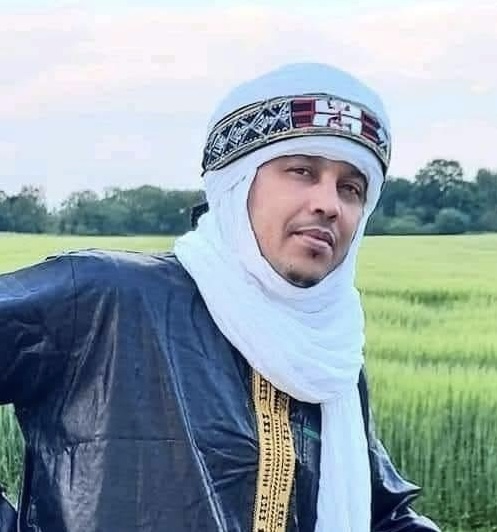
Akli Sh’kka is known across Africa and internationally as the “Man of the Sahara,” the “Black Box of the Desert,” and by many as the man who holds the keys of the Sahara. Now based in the United Kingdom, he has dedicated his life to defending the rights of the indigenous Tuareg people. He is the founder of Toumast Television, the first Tuareg TV channel, and the founder of the Imouhagh International Organisation for Justice and Transparency. A broadcaster and filmmaker, Akli is widely regarded as one of the most influential voices in the Sahara and North Africa, recognised for his deep knowledge of the region and his relationships across its diverse communities.